
Fontmell Magna is dominated by the hill known as Foretop. Back in the 1960’s, I spent my childhood in that village and recall my Father and others telling me about a golf course that used to be situated up there on the hill, and of local farmers who used to play golf there.
So, more than 50 years later, I have investigated newspaper reports and discovered the story of the Shaftesbury & County Golf Club.
On the 13th, May, 1921, the Western Gazette reported that, ‘An important event in the history of Shaftesbury took place’, the occasion being the formal opening of the new golf links for play. The place chosen for the new links are set upon a green bastion of the chalk, stretching far out into the plain from Spread Eagle Hill and known by the name of ‘Fontmell Foretop’.
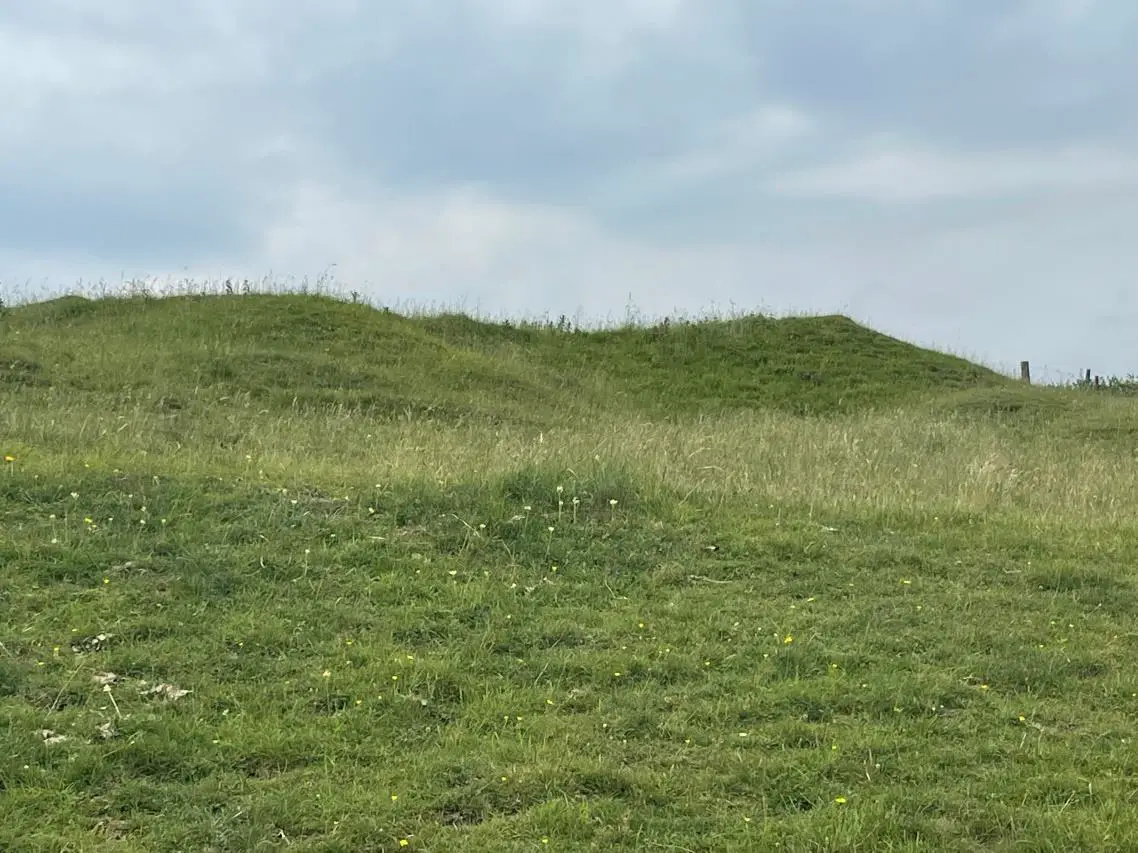
Great skill had been shown in the construction of the course and every advantage taken of the natural hazards, whether they were patches of gorse, prehistoric entrenchments, or other obstacles. The result was a sporting 9-hole course, which it was hoped might be enlarged to 18 in the future. The greens were large and undulating and well protected by fan-shaped bunkers.
The links were opened on Wednesday, 11th, May, when tea was dispensed at the clubhouse by several hospitable ladies.
There was a professional golfer there, Mr F. Jackson, who was prepared to give lessons to members at a moderate cost.
On the 25th, January, 1922, the first AGM was held at the Town Hall in Shaftesbury and it was all good news. The amount raised through bondholders & interest was just over £1,490 (£90,000 today). Outlay on course & hut construction was just over £1,415 (£85,500), which left a profit of £74-16s-5d (£4,500). This was a very healthy balance sheet although the Chairman counselled caution. The Secretary said that about 400 non-members had played the course.

Major Nixon was said to be the best and most energetic player and was re-elected as club captain.
The Chairman thanked the members and said that he thought the links were going to be a prosperous undertaking.
The Reverend C.E.Donne of Compton Abbas was re-elected as Secretary, although he said that he thought that it was not quite a parson’s job, because he could hardly use the language that some people did, if they were exasperated by their poor play.
The Chairman, Mr Hastings, said that the whole enterprise was a speculation that had turned out fortunate because of the satisfactory position they were in. He said that many more had played the course than was expected and that it was a catching disease. He also said that it was a tremendous asset to the Town. They needed a further £700 (£42,000) to make it an 18-hole course and hoped that this amount could be raised. Mr Jackson was thanked for his good work as the club professional.

5 years later, in January, 1927, the AGM reported continuing progress and increasing membership, which now stood at 140. Big improvements had been made at the clubhouse and a half rough had been created on the course.
Despite having difficulty in getting teams together, they had played various inter-club matches; unfortunately, they lost them all. In order to attract young people to the club, it was decided that those earning less than £3 per week (£185), would be granted free entry.
In 1928, the club were able to remove a restriction on a land lease that banned play on the 1st, 2nd & 9th, holes on Sundays. The new lease would run for 21 years. New bunkers were also installed at the 6th & 7th holes, with another planned for the 9th hole. A problem of rabbits damaging the course had been successfully resolved.
At the AGM in February, 1931, the club captain reported another successful year. The men had played 4 inter-club matches, winning two and losing 2; whilst the women had played 6; winning 2 & losing 4. Thanks to a dance, the club’s overdraft was down to £20. It was agreed that green fees would need to be increased. The club’s pro, Mr Jackson was thanked for his efforts and messrs Browning, Brocklebank, Harris, Hastings & Anstruther were thanked for guaranteeing the club’s bank account. Membership now stood at 138. Some land had been purchased and the committee were asked to consider getting a telephone at the club.
At the 1932 AGM, income from green fees had reached a record. However, by 1933, due to the trade depression and overwhelming taxation, clubs of every description were having difficulties in maintaining membership and financial stability. On the 19th, May, 1933, a Special General Meeting was held at the Grosvenor in order to consider the suspension of entrance fees. Membership had fallen due death and people moving from the area. It was questionable whether the club would be able to carry on without more new members.
It was agreed to reduce the men’s joining fee to 3 guineas (£240) and women’s to 2 guineas (£160), and green fees from 2s-6d (£10) to 1s-6d (£6) after 5pm on weekdays. Some changes to opening times for the sale of alcohol were also agreed.
At an AGM in February, 1936, there were just 20 members present. However, the Captain was able to report that 1935 had been another successful year and that the overdraft had been further reduced. However, membership had fallen to 110 and yearly income was still decreasing. The club was warned that it would have to face an additional increase in rates in the future.
On a lighter note, in the spring of 1937, playing in a foursome, Dr Arnott made a hole-in-one using his 3 iron on the 175 yard 3rd hole. He was one of 3 to make the green from the tee and, on arrival, found his ball in the hole.
Despite all the early enthusiasm, it seems that the course was never expanded from 9 to 18 holes.
The course was closed during the war years but, on the 4th, February, 1946, a meeting was held at the Town Hall, to consider the re-opening of the club. Any decision to re-open, was to depend in great measure on the support shown at the meeting and, despite bad weather, it was well attended and it was evident that there was a strong desire to re-open. The meeting agreed that annual fees would be 4 guineas (£190) for men and £3-8s (£150) for women; the joining fee to be 2 guineas (£95). Funds would now be needed to cover the cost of repairing the course and clubhouse. Support was promised and there was every hope that the club would start again.
On the 29th, June, 1946, the club did re-open and 40 members gathered for a game followed by tea at the clubhouse. Considering the fact that the course had not been used for over 5 years, it was in very good condition. It was decided to forego joining fees which, it was hoped, would attract new members.
Fund raising dances were held at the Grosvenor during 1947 but, sadly, it seems that the club was never again able to make a go of it and fell once more into disuse.
The remains of bunkers and the site of the clubhouse can still be seen today on that bastion of chalk and I myself have found the odd lost golf ball amongst the gorse out on Foretop and wondered when it was lost and by whom.
I have played a lot of golf at many courses over the years and have lost quite a few golf balls in the water, the rough or out of bounds. It can be quite exasperating, and I am sure that the Reverend Donne would certainly be covering his ears on hearing some of the language used by some players today.
It is a pity that Shaftesbury’s golf club didn’t survive. I’m sure it would be well used these days, when golf has become more popular to so many more people.
Western Gazette 6th February 1925.
Shaftesbury golf amenities.
Letter to the Editor.
Sir, – Once again Shaftesbury is the scene of one of its eternal quarrels. This time it is the members of the golf club who are in sharp disagreement, and the tide of bitterness is running high. The gist of the disagreement seems – to the uninitiated – one that never could have arisen in a well-conducted club. The reasons for the trouble are twofold. Firstly, that a fierce gale caused great damage to the club house, which necessitated costly repairs; secondly, the ample revenues of the club (consisting of 120 members) would seem to be rashly squandered by five or six members, who seem to be cynically determined to run the course as their own private club at the expense of all the other members. To one who did not know Shaftesbury well, such a state of affairs would seem incredible – but is once again the old tale of one or two persons setting themselves up as little tin gods, and, with their group, riding rough-shod over the rest of the community. Faced as they were early in October with the necessity of raising over £100 for repairs, and absolutely no funds in hand, what did these few autocrats do? Retrench? Cut down wages by stopping all unnecessary work on the course? Not a bit of it! They calmly went on with extensive and quite unnecessary alterations to bunkers and greens, employing three men to idle away a wet stormy, winter, when one man could easily have done all that was strictly needful on the course for the worst five months! Almost enough on wages alone could have been saved to meet the bill. Once honourably free from debt they could have gone on merrily with their fads and fancies, which were quite unwanted by most of the members.
When the question of raising £100 arose, what did they do? Sent out an urgent appeal to all members to subscribe one guinea each! Considering the number of children and non-playing members, the response (nearly £70) would seem to have been generous. But the autocrats, far from being content, threatened to raise the subscription, and in their usual high-handed manner, would have done so had it not been vigorously pointed out that such a course would not be legal, as many of the yearly subscriptions had already been paid in.
On Thursday, January 22nd, at the general meeting, this suggestion was nevertheless pressed, but for once they seem to have met their match, for the opposition to all their proposals was so strong that they were faced with an unprecedented state of affairs – for the first time they have failed to force their will, and the solution is still to find!
The trouble has come to a head through the neglect of the ordinary work on the course all the winter months. Many members have risen in revolt and are speaking their minds freely on the subject of a public club being run for the benefit of a few members, who state that they have no intention of looking after the greens during the winter months, as they are only interested in having the course in good condition for their own matches in the summer! Seeing that many members only join in an endeavour to shorten the eight dreary months in the country, it seems somewhat hard on them!
To sum up, it does seem a pity that Shaftesbury people should always be giving these exhibitions of their peculiar temper – and ethics! In the interests of sport in general and golf in particular – not to mention the fair name of our county – I do think an end should be made to such a state of affairs.
I am yours truly. AN OLD DORSET GOLFER.
Western Gazette 13th February 1925.
Shaftesbury golf amenities.
(Fontmell’s Charlie Andrews responded)
Letter to the editor.
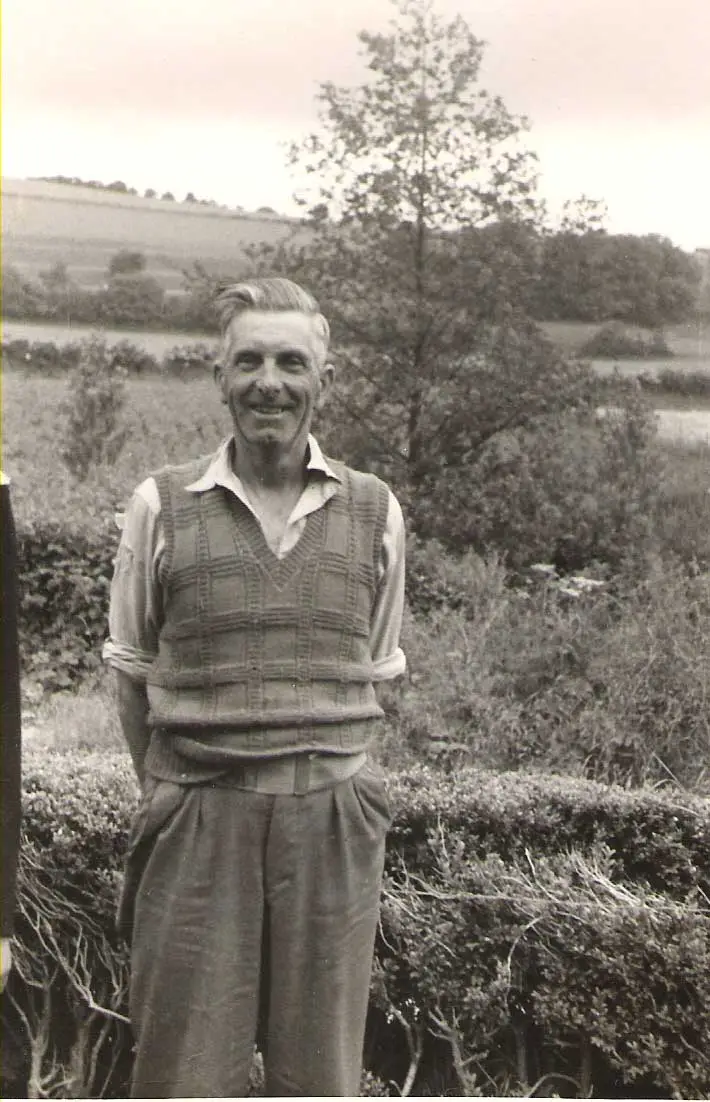
Sir – In answer to the letter published in the “Western Gazette”, and written by “An old Dorset golfer”, I should like to know if using an axe and a shovel is “Idling away time”. As to the weather, if too wet to work, I had to lose time, and having to walk two miles to work, and then, perhaps, do a half-day’s work, and get wet through at that, sometimes doing two and a half days a week. I fail to see why it should have been inserted in the letter about three men to “Idle away a wet, stormy winter”. Does the writer realise that is damaging a man’s character? At the same time, would the golfer like to have changed places?
I am yours truly,
A. E. ANDREWS (One of the three).
Fontmell Magna, Shaftesbury
Author: Dave Hardiman


